
An Imperfect Guide to Data and AI Tools for Transport Planners
Formal public transport or transit planning is a relatively new practice in the Philippines. The preparation and approval of mobility or transport plans by government authorities gained momentum when the national government required local government units to have a Local Public Transport Route Plan (LPTRP) to serve as the backbone for a program to modernize our commuting experience.
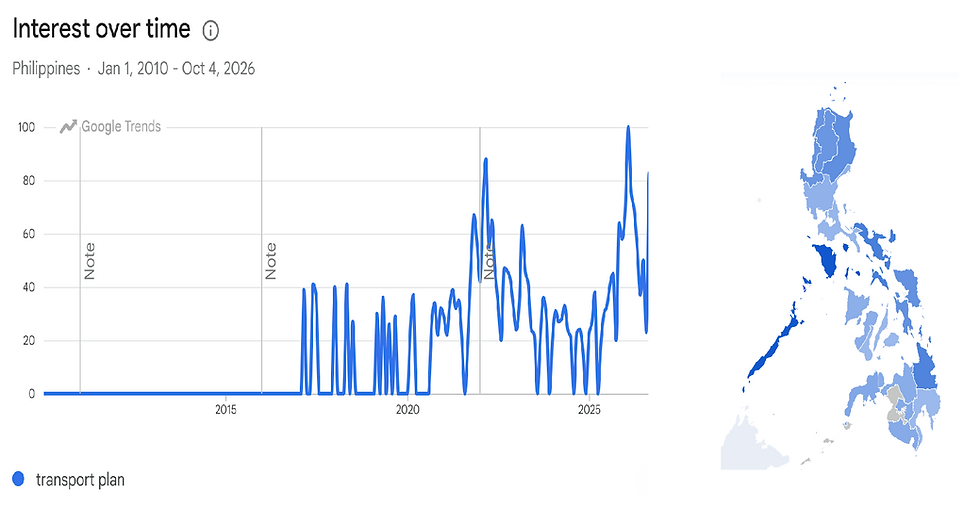
Google Trends offers a glimpse of this emergence: Philippine searches for “transport plan” become visible around 2017, when the government launched its modernization program, with peaks in 2022 following the pandemic’s commuting disruptions and again in 2026 amid the fuel crisis. Perhaps people increasingly look for a plan when moving around becomes difficult.
The use of data and analytics, and now AI, for planning and monitoring has never been more relevant. Recently, SafeTravelPH members were tapped to support a capacity-building program for Department of Transportation (DOTr) staff. The sessions revisited the progression of PT planning in the country, including the data requirements, frameworks, and systems that may or may not have helped the program reach its current state.
This article expands on the key learnings and insights from that activity. It also draws on the perspective of a transport planner and researcher, with a fresh perspective from an upstart transport engineer as co-author.
Humbly, we aim to showcase here an imperfect guide for all transport planners, engineers, researchers, operators, regulators (and AI agents?) who may have been trained to see the complex world of mobility as a data-fied and deterministic exercise in which we can arrive at precise conclusions and results.
But as our training sessions and discussions within them emphasized, the Philippine transport system involves a complex interplay of infrastructure, people, behaviors, politics, economy, and technology, among other factors.
But mobility should not be rocket science, right? It is supposed to be simpler and shouldn’t require people with a master’s degree. Yes, it is not rocket science.
Rocket science is a complicated system because it has many strict steps and interacting parts, but it is less complex and unpredictable than human-driven social systems like public transport. (And here's an interesting debate on why it may be safer than car travel.) Rocket science is hard, but it has well-established steps, scientific foundations in the physical world, and calculations.

Road-based transport planning and management is much more complex. It’s a stressful job--go ask you friends working in this field. Similar to the broader practice of urban planning, it’s actually an art between technical work and socio-political muddling (*our professors in urban planning and the social sciences nod in unison). (And yes, your transport team should be interdisciplinary.)
Meanwhile, data can be just the start of a larger process of analysis and rationalization. Or, when data work is not done cooperatively and openly, it can become the foundation for conclusions that promote divisive interests--sales of modern jeepneys, the introduction of app-based services when transit options are becoming unreliable, or irrational funding of transport projects.
The Data-fication Promise
Urban systems datafication is the current drive of governments and business firms to transform most facets of metropolitan living--including traffic patterns, utility consumption, human mobility, and social activit--into measurable digital indicators for tracking, evaluation, and automated governance. (Smart!) The goal can be a combination of faster public service delivery, cuts in government or business operating expenses, predicative population monotoring and control systems, and products with popular branding for the public and those who govern.
Relatedly, given enough real data for training or context, our AIs nowadays can produce a colorful route map with some accuracy in 67 seconds. Buy enough tokens,and in 6-7 hours it can produce an entire transport plan, complete with the government-prescribed chapters.
Outside the hype though, planning still involves and revolves around primary and face-to-face data collection and fieldwork. It involves talking to stakeholders; documenting the interests and influence of the public, government agencies, and officials; conducting research and evaluation; and building, testing, and validating models or scenarios.
It also involves practicing what planners call “the art of muddling through,” making room for incremental action, tactical planning along big-picture planning (masterplanning), and consensus-based policy-making.
The amount of data and human input required depends on the objectives. We have to establish those objectives firmly at the outset. The cost of public transport planning data work and the human effort involved follow from what we are trying to accomplish.
Do we simply need a public transport network that provides the most direct connections between areas with the highest density and daytime activity?
Do we want commuters’ waiting times to be at most 3 minutes only during peak hours?
How do we serve passengers reliably while ensuring that jeepney drivers do not end up earning less per hour than a minimum-wage worker?
These questions keep surfacing in planning conversations. They become more complex as findings--and the things we still do not know--are discussed transparently. Fortunately, methods advanced by science and research for math-ing out possible solutions have been around for years. As adults, though, planners can be excused from doing long division by hand when a calculator is available.
Still, in the age of quick results and AI slop, we hope humans will take the time to understand the processes again.
AI agents can be given instructions to prioritize particular skills and procedures within the computing power and resources available (look up `SKILL.md`). Humans need opportunities to develop their capabilities too.
Capacity-building or training programs for humans are there not just for preparing us for the day our subscriptions expire, or when an actual human asks a follow-up question about the AI-outputted work.
Competency building is also about learning and unlearning along the human path to intelligence. In our case, answering the question:
How might we create a dignified transport system for everyone?
For better or worse, professionals are moving from more complicated work toward easier prompt-based workflows and quick dashboards. During the training sessions, we described the progression of tools this way:
Before: Spreadsheets serving as both the dataset/database and the analytical tool, with formulas and built-in statistical functions.
Recent: Programming, analytics, and visualizations for large datasets using R and Python.
Now: Generative AI prompts; quick charts.
Each step makes certain tasks easier. It also changes how much of the underlying work the user sees and understands, leading to what Harvard published back in 2017 as the blackboxing of intelligence and failure of intent and causation.
In the Philippines’ still-young public transport planning profession, we argue that learning should be more intentional and effortful. We are still developing the competence needed to ask good questions, examine assumptions, and defend recommendations. There is a cost to skipping those experiences just because some tools can already produce an average output.
The Guide
TLDR? Check out the guide in this next post: An Imperfect Guide to Data and AI Tools for Transport Planners Part II. And it is actually a bit longer.


